Atheist Holy Day!

>> Tuesday, March 31, 2009

The following was sent to me by a cousin who lives in Florida.  I thought it was too good not to share.

In Florida, an atheist created a case against the upcoming Easter and Passover holy days.  He hired an attorney to bring a discrimination case against Christians, Jews and observances of their holy days.  The argument was that it was unfair that atheists had no such recognized days.  The case was brought before a judge.  After listening to the passionate presentation by the lawyer, the judge banged his gavel declaring, “Case dismissed!”

The lawyer immediately stood objecting to the ruling saying,  “Your Honor, how can you possibly dismiss this case?  The Christians have Christmas, Easter and others.  The Jews have Passover, Yom Kippur and Hanukkah, yet my client and all other atheists have no such holidays.”

The judge leaned forward in his chair saying,  “But you do.  Your client, counsel, is woefully ignorant.”

The lawyer said,  “Your Honor, we are unaware of any special observances or holidays for atheists.”  The judge said,  “The calendar says April 1st is April Fools Day.  Psalm 14:1 states, ‘The fool says in his heart, there is no God.’  Thus, it is the opinion of this court, that if your client says there is no God, then he is a fool.  Therefore, April 1st is his day.  Court adjourned.”

Read more...

New Kids on the Farm

>> Friday, March 27, 2009

As I stated in an earlier post, one knows spring has arrived when the baby goats begin arriving.  Our three goats all had their babies this month.  The first to kid was our young goat, Zoe, a first freshener.  She had twins, however, the first one was stillborn and for some reason the “mothering instinct” just never kicked in and Zoe would not accept the second baby.  We were able to hold it up to nurse several times and then gave it to a lady who wished to raise it on the bottle.

Our “old” goat, Annie, also had twins and they were by far the largest ones born.  We were happy she had only two as 3 years ago she had quads.  She managed to raise them all with a bit of help from us and some goat milk replacer.  The last to kid was Brownie and she also presented us with twins.  Her previous 2 kiddings she had had only a single baby.

All 4 of the remaining babies are doing great.  Yesterday Darryl and I disbudded all 4 and “banded” the 2 little males.  The banding does make the little kids quite uncomfortable for a few hours but they are up and bouncing around today and you would never know they had gone through such and experience.

Here are a few photos of some of the new kids.  Just like a lot of other kids it is hard to get them to hold still long enough to get a good picture.

Mar              17th 002 Mar                 20th 018  


Mar                 20th 019 Mar                 20th 024

Read more...

Azada, Powrah, Changkol, Jembe or Grub Hoe

>> Wednesday, March 25, 2009

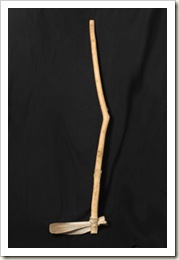
Perhaps the most ancient and the most widely used agricultural tool is the hoe. The earliest known hoes were forked sticks. Hoes have been made of animal antlers and shoulder blades, of shells, of flaked stone and of course, various types of metal.

90px-RomanHoeBlade DSC_1839 On the left is a hoe made from bison scapula or shoulder blade. The photo on the right is of an old iron Roman hoe. Some of the earliest inhabitants of the Americas used hoes made from the bones of the animals they killed for meat, from mussel shells and of stone.

hoenotchedsmkaolinrittertrism This photo, taken from an internet site, shows the front, back and side of a chipped or flaked stone hoe. Most of us are quite familiar with the common garden hoe, a light-weight metal hoe used for weeding and digging the surface of the soil.

But, the hoes used by the majority of the people of the world, especially third word countries, is of a much heavier type.

hoe_3 In many areas the hoe that is commonly used has a very short handle, causing numerous back problems. As pictured here, the blade is quite long and heavy. It enables the user to dig deep into the soil. Longer handled hoes make the job much easier for the user and makes for easier digging of the soil than using a shovel or digging fork.

AW005233 The Chinese man in this picture is holding two of this type of hoe. And, as I mentioned in my title they are called by many different names around the world. They are known as azada in Europe and South America. In India they are called powrah, mammoty or mamooty. In parts of Asia they are known as changkol or changkul. And, in Africa it is known as jembe. In Okinawa it is called a kuwa, kue and gawa, where it is also a traditional Martial Arts weapon.

Last summer Darryl, Danny and I all purchased grub hoes. The grub hoe makes digging and cultivating with an easy chop-pull motion that is quick, but is SO much easier and gentler on the back than the stomp-bend-lift motion used with a shovel or spade.
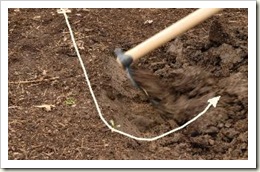
digging_with_arrow-315x199 The above illustration shows the motion used. The following is taken from a web page of a company selling the grub hoe. “

Using a grub hoe (also called an Azada) is very different from using a shovel or spade. Instead of stomping or ramming a
shovel blade into the earth, the heavy-duty grub hoe blade swings from hip height down into the soil using it’s own weight,
gravity, and a little help from your arms. Instead of leaning over to lift the shovel load of soil with your back, with the long
handled azada you use your whole body to pull the thin slice of soil towards you into a previously cleared space.” I have had lower back problems for many years and I can attest to the truth of the above statement. Digging with a shovel or spade causes me a great deal of discomfort, but, although I need to rest occasionally, I am able to work up a fairly large area without having back pain.

The grub hoes we bought are 6 inches wide with a 5 foot long handle and weigh 3 pounds. A lighter weight and narrower version is available. For working small areas and raised beds they are much better than a roto-tiller. In fact, I am able to dig down deeper with the grub hoe than I could with a tiller. That is how I managed to hit the rocks I talked about in my last post.

A related hoe that we also purchased is the Italian grape hoe. The hoe is somewhat lighter in weight and is set at a sharper angle. It is “the fastest, sharpest weeding tool in the world.” It is really great in taking out heavy sod or weeds and grass that have gotten a “toe hold.”

For more information please check out the easy digging web site.

Read more...

My Garden Rocks!

>> Sunday, March 22, 2009

In a recent post, Please Pass the Dressing, I recounted hauling and spreading “dressing” from the local stockyard on my garden.  As Darryl’s tiller is at the bottom of the hill I decided to work the “dressing” into the soil with my grub hoe (I’ll do a post on that soon).  I also mentioned in the above referenced post that I have rock very near the top of the ground.  Well, some was very close.  I hit it with the grub hoe at a depth of only a few inches in the middle of the area I was working.  I attempted to dig it, or rather, them out.  There was one large flat rock on top of another.  I didn’t get them all but as you can see from the following photos I got several.

IMG_3527 In the foreground is the pile of rocks I had already removed.  As you can tell, I have dug a good sized hole in getting them out.

IMG_3534 Here I’m wrestling another large rock out of the hole.

IMG_3538 And it is added to the growing rock pile.

IMG_3540 Another view of the pile of rocks taken from the one small area of the garden.  When I attempted to fill the hole back in with soil I found that I need more, I have quite a depression to fill in.

Anyone need some rock?

Read more...

Fishing

>> Saturday, March 21, 2009

As a boy I spent a lot of time on the creek bank fishing.  As an adult I have not fished often but still enjoy it.  Last summer I told the grandkids I would try to take each of them fishing, one at a time until they learned a bit about it.  I managed to take Jessica but just never did get the boys up to the county lake.  Yesterday morning was quite nice, although cool.  I dug a few worms and asked Ramiah’s mother if he was free to go fishing.  He had to finish his job of replenishing the wood pile on the porch and then he would be able to go.  It didn’t take him long to get that job done.

We drove up to the lake and began our fishing.  However, the fish didn’t seem to know we were there.  They just weren’t biting.  I got one little nibble and Ramiah did finally get a bite.  And, he caught his first fish, not a big one, but a fish.  He was quite excited about it.

Mar                 20th 001

Read more...

Please Pass the Dressing!

>> Thursday, March 19, 2009

In my profile I mentioned the series of books by Ralph Moody that I have enjoyed reading.  In The Fields of Home written and copyrighted in 1953 he recounts the time he spent living with his grandfather in Maine.  One item that has stuck with me was his grandfather’s way of speaking of various tasks.  When it came time to clean out the barn he spoke of spreading the “dressing” on the fields.  I have jokingly used that phrase myself.

Today I hauled and spread “dressing” on part of my garden and piled up some for Connie to put into her flower beds.  The local stockyard clean out their pens and aisles on Thursdays and gladly give away the “dressing” they pile out in the yard.  What isn’t given away they have to pay to have hauled away.  They gladly load it for you if they are available, although I have used a shovel and loaded my own loads a few times in the past.

Mar                19th 001The “dressing” is well mixed with sawdust that is used as bedding.  Here a bucket load is being taken from the big pile.

Mar                19th 002  The first bucketful is dumped into my little trailer.

Mar                19th 003 With a trailer load of “dressing” I have arrived at home, ready to unload and beginning putting it onto the garden.

Mar                19th 004I shovel it into my trusty wheelbarrow and wheel it to the garden.

Mar                19th 005  You can see in this photo that I have dumped the wheelbarrow loads and it awaits being leveled out.

Mar                19th 007 Now it awaits being rototilled into the soil, adding fertility and humus to the garden.  As there is rock not very far beneath the surface every bit of humus that we add helps with water retention.  And, I believe natural fertilizer is much better that the man-made chemicals that so much of the agricultural community uses.

Read more...

Five Years!

Today, March 19th, is our anniversary!  No, not our wedding anniversary, but of our move to Kentucky.  Five years ago this morning we met the buyers of our house in Bloomington, Illinois at their bank for the closing and then were on our way.  I drove the moving van and Connie our little truck.  We had our oldest son’s set of walkie-talkies with us to keep in contact.  About 6 P.M. we arrived at the old mobile home we had rented, called Darryl, ate a peanut butter sandwich and it was off to bed,  or rather the air mattress.

Five years has seemed to have gone by quite rapidly.  We are still enjoying life here in the hills of south-central Kentucky.

Read more...

  © Blogger template Sunset by Ourblogtemplates.com 2008

Back to TOP