Connie’s Flowerbed

>> Friday, May 15, 2009

Connie enjoys flowers and shortly after moving here to the farm I dug up an area in front of our parking area for a flowerbed.  I remember that the soil was full of small rocks, I must have thrown out bushels of them.  She added compost and manure but it seems she continued to have some difficulties.  The soil dried out quickly and perhaps one of the biggest problems was that the ground sloped.  Flat land is hard to find here on the ridge.  I told her that I would put landscape timbers around the area and level things out.

I got that done last week.  I carried up 25 five gallon buckets of dirt from the side of the hill plus added 3 wheelbarrow loads of “dressing” from the stockyard.  I’m sure more soil will be needed as everything settles but she has been busy getting plants set out and some seeds planted.  Here are a few photos.  We will have to revisit after the plants have grown and are fully in bloom.

May  13th 004 May  13th 005


May  13th 006 May  13th 001

Read more...

The American Tulip Trees Are Blooming

>> Monday, May 11, 2009

Commonly known as the American tulip tree, tulip poplar, yellow poplar or tuliptree magnolia, Kentucky’s official state tree is now blooming. Locally they are most often called poplar trees or tulip poplars, although they truly are a member of the magnolia family. They are native to eastern North America from southern Ontario and Illinois eastward across southern New England and south to central Florida and Louisiana. They are a valuable hardwood tree that is fast-growing. The wood is white in color and in some areas the tree is given the name Whitewood. Native Americans used the tree for making their dugout canoes and early settlers west of the Appalachian Mountains called it Canoewood.

The resemblance of its flowers to tulips resulted in it being called the Tulip-tree. The flowers are pale green or yellow with an orange band. Below are photos of the tulip poplar just on the edge of our back yard with its many blooms.

May 10th 001 At a distance it is difficult to see the many blooms.
IMG_5135 Here is a view zoomed in. The blooms are much more obvious.
IMG_5133 Here the tulip shape of one of the blooms is quite apparent.
May 10th 009
I picked from another nearby tree a couple of leaves and a bud that has yet to open and placed them into a vase. I hope to see the bloom open up.

Read more...

Whip-poor-will?

>> Wednesday, May 6, 2009

Growing up on a small farm in East-Central Illinois I often fell asleep in the summertime listening to the call of the whip-poor-will. If you have heard the repeated “whip-poor-will, whip-poor-will” call I’m sure you will never forget it.

When we first moved here to South-Central Kentucky we heard a nighttime call of a bird that some referred to as a whip-poor-will. But, it seemed to have forgotten it’s lines. The call was different. Connie said it sounded to her more like “weird will.” We finally found out that it was a larger cousin of the whip-poor-will called chuck-will’s- widow.

Listen to the difference. First the whip-poor-will. Now the chuck-will’s-widow.

We have heard the “real” whip-poor-will once or twice since we have been here but it doesn’t seem to be a permanent resident. The chuck-will’s-widow is heard almost every night, and sometimes it seems to be right outside our window. Since both are nocturnal we have never actually seen one. Perhaps someday.

whippoorwill01 Obviously since I haven’t seen one these photos were not taken by me, but borrowed from the internet. On the left is a whip-poor-will. It is about 9 3/4 inches long. Chuck-will’s-widow, below, is larger and redder. The chuck-will’s-widow is about 12 inches long.

CHUCKW-1

Read more...

Concrete Blocks

>> Tuesday, May 5, 2009

Early last week Darryl received delivery of a load of concrete blocks to be used for the walls of the root cellar he is building as part of his new house.  I helped him move 450 blocks down into the cellar that afternoon.  We commented on the weight of those blocks, which was about 36 pounds each, and I reflected on a concrete block that I have which weighs 56 pounds.  It is one of about 2000 to 2500 that my dad made back in the late 30’s and early 40’s.


In 1936 my dad and mother bought a 20 acre parcel in Illinois with an old house and a few old buildings.  They were all in need of repair or replacement.  Within  a few months my dad began to build new buildings.  His records show that he purchased 13 truck loads of gravel (at $1.00 a load) and a few days later a used “block machine” for $6.50.  Using this machine he made all of those 2000-2500 blocks.

I know it is not common today but in the early 1900’s these machines were sold through Sears, Roebuck and Co. catalogs as well as directly by the manufacturers.  I found by doing some research that in 1908 Sears, Roebuck and Co.  was selling the “Wizard Concrete Building Block Machine” for $42.50.  In their 1917 catalog they were offering a machine for about $60.00.  I have no idea how old the machine was that my dad purchased but it did the job making, I believe, 3 blocks at a time.
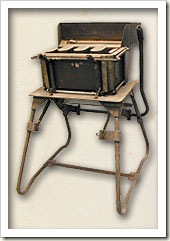
sears-sm This photo of a block making machine  was taken from the 1940 Sears catalog.  I’m fairly sure that this would have been similar to the one my dad used.

Garry's pictures 086 Here is a picture of the block that I have, one of the  2000 plus that my dad made.  As I mentioned, it weighs 56 pounds.  To make the number of blocks that my dad made he would have had to have used 56 to 70 tons of sand, gravel and cement.  And, that was all handled by hand, a shovelful at a time.  It makes my back tired to think of it.

To check out the work Darryl is doing on his house, on the cellar and to see pictures of his progress please check out his Cedar Ridge Farm blog.

Read more...

Everything’s Green!

>> Monday, May 4, 2009

It seems that everything has become green within the last couple of weeks.  The grass has become green.  The trees have their leaves and are very green.  It doesn’t matter which way one looks, everything is green.  Here are a few photos I took a few minutes ago from around the yard.

May 6th 001 May 6th 002


May 6th 003 May 6th 004


May 6th 006 May 6th 007


May 6th 008 May 6th 010


As you can see the trees all around us are very green, the grass is green, the strawberry plants are green, the lettuce is green BUT they aren’t all the same boring shade of green.  So many shades of green!  One would think that the Creator’s favorite color must be green.

Read more...

More Trees in Bloom

>> Sunday, May 3, 2009

As I mentioned in an earlier post we have many kinds of trees that bloom throughout the Spring and early Summer here in  South-Central Kentucky.  One tree that is in bloom now is a tree that I was quite unfamiliar with when we moved here.  We saw quite a number of the trees in bloom throughout the area and it seemed that the people we asked didn’t know what they were either.  Darryl finally found them pictured and described on the internet.  They are the Royal Paulownia, named after Anna Paulownia the daughter of the Czar of Russia, also called the Royal Empress Tree or Princess Tree.  They are native of China and are known as the the world’s fastest growing tree, growing as much as 12 to 15 feet per year.

The wild trees are considered to be an “invasive exotic tree,” meaning they will spread and become a nuisance.  Some now being sold by garden supply companies claim to be “cloned” so that they do not produce fertile seeds.  The trees produce clusters of lavendar flowers.  We do not have any of the trees here on the farm and Darryl doesn’t want any due to their invasive proclivities.  There are a couple on the adjoining farm but I haven’t had the chance to photograph them.  The picture of a Royal Empress Tree in bloom, below, was taken from an internet site.

royal_empress_tree Another tree that is currently blooming here in the area is the locust.  I believe it is properly called a black locust.  Here are a couple of photos taken about a mile from here along the road.

IMG_7674 It is hard to tell in this picture but the blooms are very white.  Below is a close-up.

IMG_7679 Bees love these flowers and the black locust tree, which is a legume (a member of the pea family), is a  major  “honey” plant in many areas.  They are quite impressive when full of bloom as they are now.

Read more...

We Have Some New Babies!

Early in April one of our Light Bramha hens became broody and I put nine eggs under her in a small enclosure I built some time ago.  She sat on those eggs diligently for three weeks.  Friday morning I heard peeping sounds coming from under the hen.  When I checked I found that we had 5 new babies.  One poor little chick never made it out of the shell and 3 eggs did not hatch for whatever reason.  The little ones seem to be doing quite well.

April     30th 003 The hen sitting on the eggs just a few days before the babies arrived.

April     30th 005 Here is the new momma and babies, photo taken this morning.

Read more...

  © Blogger template Sunset by Ourblogtemplates.com 2008

Back to TOP